During load testing, room ticks began overrunning their 50 ms budget as simulated clients reached target density. Normal ticks took 10–20 ms; spikes took 100–300 ms, leaving clients two to six ticks behind. We had built the room service for a QQ-licensed casual pet game. It was designed for tens of millions of users; actual peak concurrency reached roughly 200,000 players.
I led the architecture selection and ECS implementation. Profiling showed how much CPU time component lookups consumed.
Designing for 10,000 players per instance
Tencent's publishing team planned to roll out access in stages. The service needed to absorb each traffic increase by adding instances. Load tests used a fleet of slightly lower-spec instances running bots through the real client protocol: entering rooms, moving, and collecting. The target was 10,000 real players per server instance: about 667 rooms with fifteen players each, updated at 20 Hz.
Late room-state updates led us to investigate the room's serial update cycle.
Outside rooms, another service handled idle collection through request-response calls. Inside rooms, players shared a grid of up to 200×200 cells for movement, exploration, combat, and collection. Clicking a destination triggered server-side pathfinding. Player movement step size was defined separately from the simulation tick. A room held about fifteen real players, 30+ combat NPCs, and a varying number of bot players, with a room capacity of 30–100, depending on room class. The room service updated shared state on each tick, with three constraints:
- Responsive movement. Delayed server updates were visible to players.
- A bounded update cycle per room. Each room updated every 50 ms (20 Hz), and all work for that tick had to finish within the interval.
- Bounded broadcast fanout. Room population and visibility limits had to cap the audience for each update.
Choosing the room boundary and its execution model
I made two choices: which state each execution unit would own, and how it would run the simulation. Actor-style ownership determined who held mutable state and how work reached it. ECS determined how components were stored and systems iterated over them.
Keeping shared state within one room
Giving each player its own actor would separate ownership of player state, but interactions involving multiple players and shared room state would require coordination between actors. For example, if two players claimed the same collection cell within one tick, an actor implementation could resolve the conflict by giving a room actor authority over the cell and routing both claims to it. The cost is forwarding requests, returning results, and defining when the player actors apply those results. Visibility queries, movement collisions, and PvP interactions raise the same ownership question. I kept the interacting state under one room owner, so these operations could complete within one simulation pass.
An actor-based design can also batch inputs and resolve them in a stable order; Proto.Actor provides a Go implementation of actor messaging. When player state is split across actors, the design must also define tick boundaries and coordinate the state used in each tick.
A single global simulation loop would couple unrelated rooms: a slow room would delay the others, and the serial loop could not use multiple processors.
Choosing ECS for the room interior
The closest alternative was a room-level actor: one goroutine and mailbox per room, with entities stored as objects and events handled by methods. It provided the same ownership boundary as the shipped design. In the candidate design, handlers processed messages in arrival order and dispatched each event separately. My tick-based design batched the frame's inputs and let systems query components directly for operations such as finding the players within an area of interest (AOI).
I chose ECS to support frequent gameplay changes inside existing rooms. Components held buff effects and expiration times; systems applied the effects in tick order. Items could reuse the same components and systems. Adding mechanics this way reduced branching in player objects and message handlers.
I could order buff application, movement, damage calculation, and expiration explicitly, with no concurrent writes inside the room. Fixed inputs and simulation time made interactions between mechanics easier to reproduce in tests.
The speed-item example below uses an array-based ECS.
EntityID indexes the component arrays, and masks record
which components are present on each entity. Room.Tick runs
item application, buff expiration, and movement serially. Adding or
removing a component changes membership while retaining its
pre-allocated slot.
Each tick simulates the 50 ms interval beginning at
nowMS. Buffs are active on
[appliedAt, expiresAt), so a buff expiring at 100 ms does
not affect movement over [100, 150). Durations align with
ticks, and each player can have one speed buff. Positions use
thousandths of a cell; distance depends on speed and elapsed time.
Save as main.go and run go run main.go:
1 | package main |
Output (positions in thousandths of a cell):
1 | [0,50) ms: positions=100,50,0 buff=true |
The position-only entity stays still, and the control player keeps its base speed. The buffed player returns to base speed at the expiration boundary.
A room-level actor could implement the same gameplay and tests, including ECS internally. In the candidate's event-handler design, interactions between effects would require ordering rules across handlers. I chose component composition and an explicit system sequence to keep those rules together as gameplay grew.
In the shipped service, one goroutine owned each room's mutable state, and Go's runtime scheduled room goroutines across the available processors. Systems ran serially within that goroutine, accessing components for the relevant entities on every tick.
Cross-room state lived on a separate tier with its own consistency rules, so features spanning rooms required additional coordination.
A slow entity could delay its room's tick while unrelated rooms continued, provided the process and scheduler stayed healthy. Extra cores could run other rooms, but could not shorten that room's serial tick. A room that exceeded its deadline needed less work per tick, further optimization, or a lower population cap.
Room scheduling, serial ticks, and state management
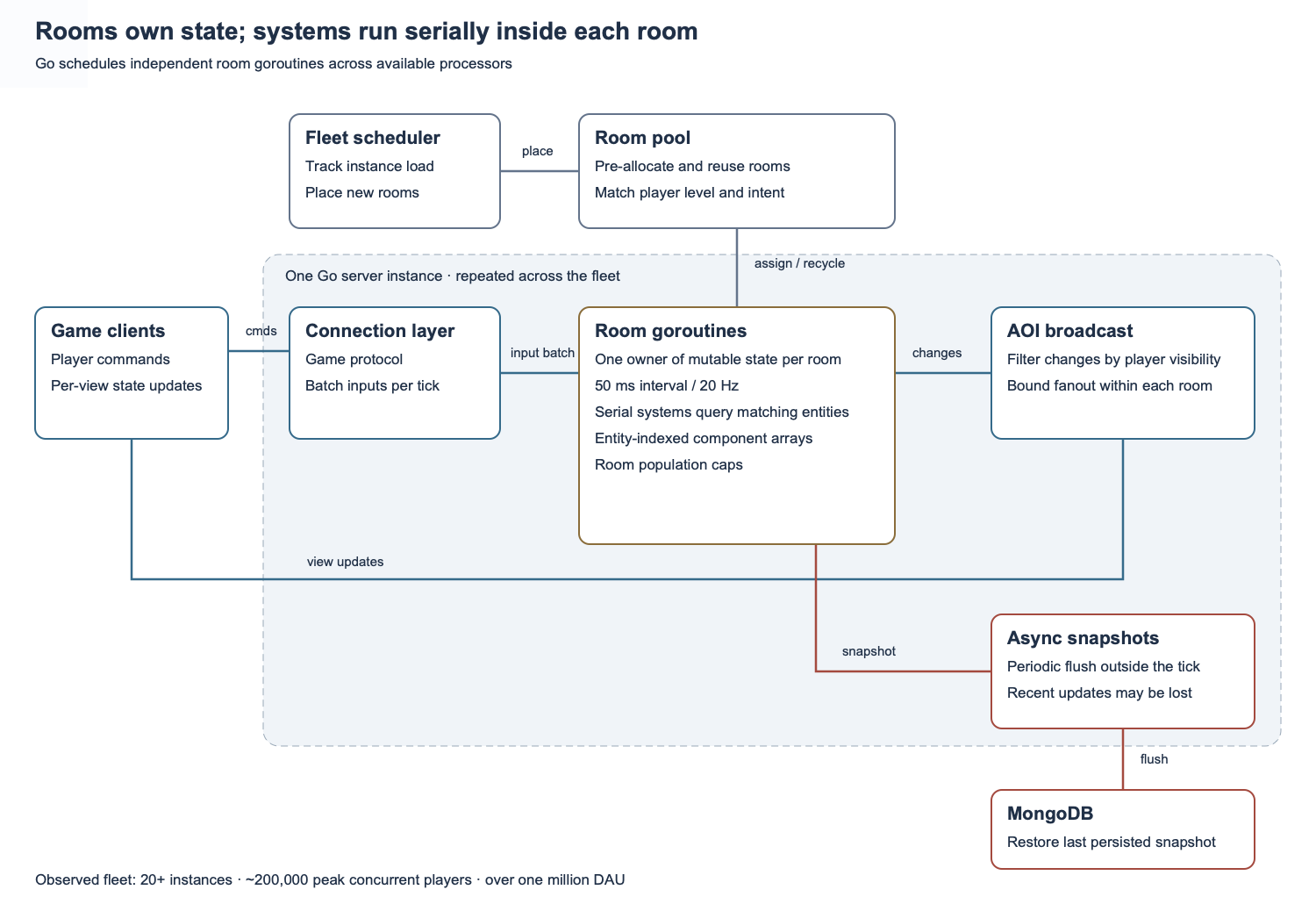
Each instance pooled rooms, pre-allocating them to keep allocation off the hot path and recycling them as demand fell. Players joined room classes matching their level and intent, keeping new players among peers. A central scheduler tracked instance load and placed each new room on the least-loaded instance.
I initially stored components in entity-keyed maps to support changing entity counts without reserving full-capacity arrays for every room. Rooms with fewer entities could allocate storage as needed, though maps carried their own bucket and key overhead. Each system looked up components while iterating its entities. Player input arrived through the connection layer; each tick consumed the inputs accumulated since the previous update.
State changes were sent only to players whose area of interest included the affected location. PvP interaction used the same visibility boundary. AOI filtering and room population caps bounded broadcast fanout.
Persistence ran outside the tick. Room snapshots were taken asynchronously and flushed periodically to MongoDB. A restart restored each room from its last persisted snapshot, potentially losing subsequent updates. That was acceptable for this casual game. Snapshot flush lag and the recovery loss window were not measured; I would add metrics for both.
Map lookups exhausted the tick budget
pprof
showed map operations consuming 60–85% of the profiled CPU time. These
figures reflect the load-test results I confirmed at the time; they are
not quoted from retained profiles. The hot frame was
aeshash, Go's AES-NI-based hash implementation. The Go 1.13
runtime routed map
lookups through its hashing
functions to AESENC-based
code.
Across all systems and rooms, component lookups required roughly 13 million hash computations per second per instance, before bucket traversal and key comparison. Map insertions and growth added allocations. GC ran about once a second during the test. Entity IDs could directly index component arrays; the maps added a hash lookup to each access.
I kept the room boundary and serial system order, and replaced component maps with pre-allocated fixed-capacity arrays indexed by entity ID. Storage was reused across room lifecycles. Sequential component traversal also favored cache locality, though cache misses were not measured separately.
Pre-allocated arrays reserved space up to each room's entity cap even when occupancy was low. Room reuse saved allocation work but retained that storage. Growing arrays with occupancy or grouping entities by component set could reduce unused slots, but would add storage-management work. I accepted the reserved space to keep lookups direct and reuse storage.
After the change, p99 tick elapsed time, measured with
time.Since, fell below 50 ms, and instance CPU utilization
settled near 70%. Profiles showed less hot-path allocation churn, but I
do not have before-and-after measurements of GC pause frequency.
Broadcast fanout was not the bottleneck in this test. The tick overruns were resolved before production.
Production results and capacity
At 10,000 players per instance and fifteen players per room, each instance ran about 667 rooms at 20 Hz. A typical room contained roughly 60–80 entities: players, combat NPCs, bots, and collection objects. At that density, the 8-vCPU instance averaged 70% CPU utilization during the same load-test window. Dividing its CPU consumption by the number of room ticks gives about 0.42 ms per room tick:
1 | CPU consumption = 8 vCPU × 70% = 5.6 CPU-seconds per second |
This average includes connection handling, serialization, GC, and other instance work.
Room goroutines waited between updates, allowing hundreds of rooms to share the 8 vCPUs. We added instances as room density approached the per-instance limit.
The memory model was:
1 | memory = process_baseline + rooms × room_memory + buffers + headroom |
Estimated per-room memory was a few hundred KiB at fifteen players. At ~667 rooms per instance, that amounted to a few hundred MiB. The 16 GiB instances also provided capacity for the Go process, player connections, queues, snapshots, caches, runtime metadata, and headroom. The fleet used the same instance configuration throughout: 8 vCPU / 16 GiB on Tencent Cloud.
Concurrency outside activity peaks was in the tens of thousands. A single instance carried over 10,000 concurrent players. At activity peaks, the fleet served roughly 200,000 concurrent players across 20+ instances, with over one million DAU.
The talk Overwatch Gameplay Architecture and Netcode gave me many of the ideas behind this design, especially separating component state from system behavior and organizing data for sequential access.
**Next in this series: One Queue for Every State Change: Fixing Silent Over-Assignment in a Live QR Code System..