The legacy batch center and xxl-job had reached their dispatch ceiling, and every new instance multiplied lock contention on the same task table. We replaced them with a scheduling center on TiDB, etcd, and Apache Pulsar. Its on-the-hour workload peaked above 200K execution commands per second; production incidents later led us to revise its isolation model.
Context
At my previous company, the SCRM (Social CRM) platform served enterprise marketing teams; its product ran on delayed execution — SOP (standard-operating-procedure) sequences that move a customer through timed marketing steps, follow-up reminders, and large one-shot jobs. Two legacy components, the in-house batch center and xxl-job, covered more than twenty business scenarios with a continuously active scheduling workload.
I designed and delivered the Go scheduling center and migrated existing scenarios onto it, reusing TiDB, etcd, and Pulsar for storage, coordination, and delivery.
Four terms recur below. A job was a registered business
definition. A trigger was the durable schedule for that job: a
one-shot trigger represented one run, while a cron trigger maintained
the next occurrence in next_fire_at. A sharding
item was a fan-out unit inside a run. An execution command
was one sharding item handed to the executor through Pulsar. Throughput
counts published commands, not database scans, trigger rows, or
downstream handler completion.
Problem
Both legacy systems shared the same execution model. When a task came due, the scheduler dispatched it onto a worker and invoked a business HTTP callback; the worker stayed occupied until the callback returned. Real handlers took milliseconds to minutes. Under load, the pool saturated and production hit a measurable dispatch ceiling.
Scaling out made contention worse: every instance polled and updated the same task table, so adding instances multiplied lock contention.
            flowchart LR
    L["legacy scheduling load"]:::trigger
    D([task becomes due]):::trigger
    W["worker pool"]:::state
    C["business HTTP callback:
milliseconds to minutes"]:::pressure

    L --> D
    D --> W
    W --> C
    C -. holds worker until return .-> W
    W --> S["pool saturated;
dispatch delayed"]:::impact

    classDef trigger fill:#eef7ff,stroke:#245a7d,stroke-width:2px;
    classDef state fill:#f5f5f5,stroke:#4b5563,stroke-width:2px;
    classDef pressure fill:#fff7e6,stroke:#8a6d3b,stroke-width:2px;
    classDef impact fill:#fdecea,stroke:#a44a3f,stroke-width:2px;
Constraints and requirements
- Task state had to live in a transactional database. Tasks were coupled to business flows, and we needed state transitions to be auditable and recoverable, not buried inside message queues or caches.
- Existing business scenarios had to migrate without rewriting their business handler logic. The new system still needed an SDK and a data migration path for integration.
- Downstream handler latency was unpredictable and outside our control. The scheduler had to make progress regardless of how long business callbacks took.
- Both old and new systems had to keep serving production traffic during a gradual, verifiable per-business cutover that fully replaced the batch center and xxl-job.
- Second-level scheduling precision for delayed tasks, plus cron support for recurring ones.
- Peak publish throughput well beyond the old ceiling.
- Consumer isolation between business scenarios from the start; producer isolation became a requirement after the shared-topic incident.
Options Considered
We evaluated where to keep durable state, how to shard scheduling, and how to provide delivery precision.
Patch and scale the legacy schedulers
Adding instances or enlarging worker pools preserved the worker-per-callback model, and every scheduler still polled and updated the same task table. Sharding or partitioning that table was not drop-in either: the legacy dispatch loop would need a rewrite without removing slow-handler occupancy.
Make Pulsar the task store
Holding every future trigger as a delayed message would remove database polling, but pause, cancel, migration, audit, and recovery would become queue mutations. Long-lived business state would no longer be auditable in one transactional place.
Use etcd to shard schedulers
An etcd coordinator could distribute partitions across nodes, but the bottleneck was TiDB partition access and command delivery, not the number of leader processes. Shard assignment, rebalance, and partial-failure handling would add complexity before removing that bottleneck.
Hybrid state and delivery
TiDB remained the transactional owner of trigger state and due-time discovery. Pulsar delivered only admitted execution commands. etcd supplied election leases without coordinating scheduler shards.
Architecture / Design
The C4 container view below shows the final system after topic isolation: etcd election; the leader's partition schedulers and in-process fire pipeline; the TiDB trigger store; per-domain command topics; a separate callback topic; and the executor SDK. Arrow badges carry the protocol for each hop — lease, SQL CAS, deliver-at, consumer groups, or callback event.
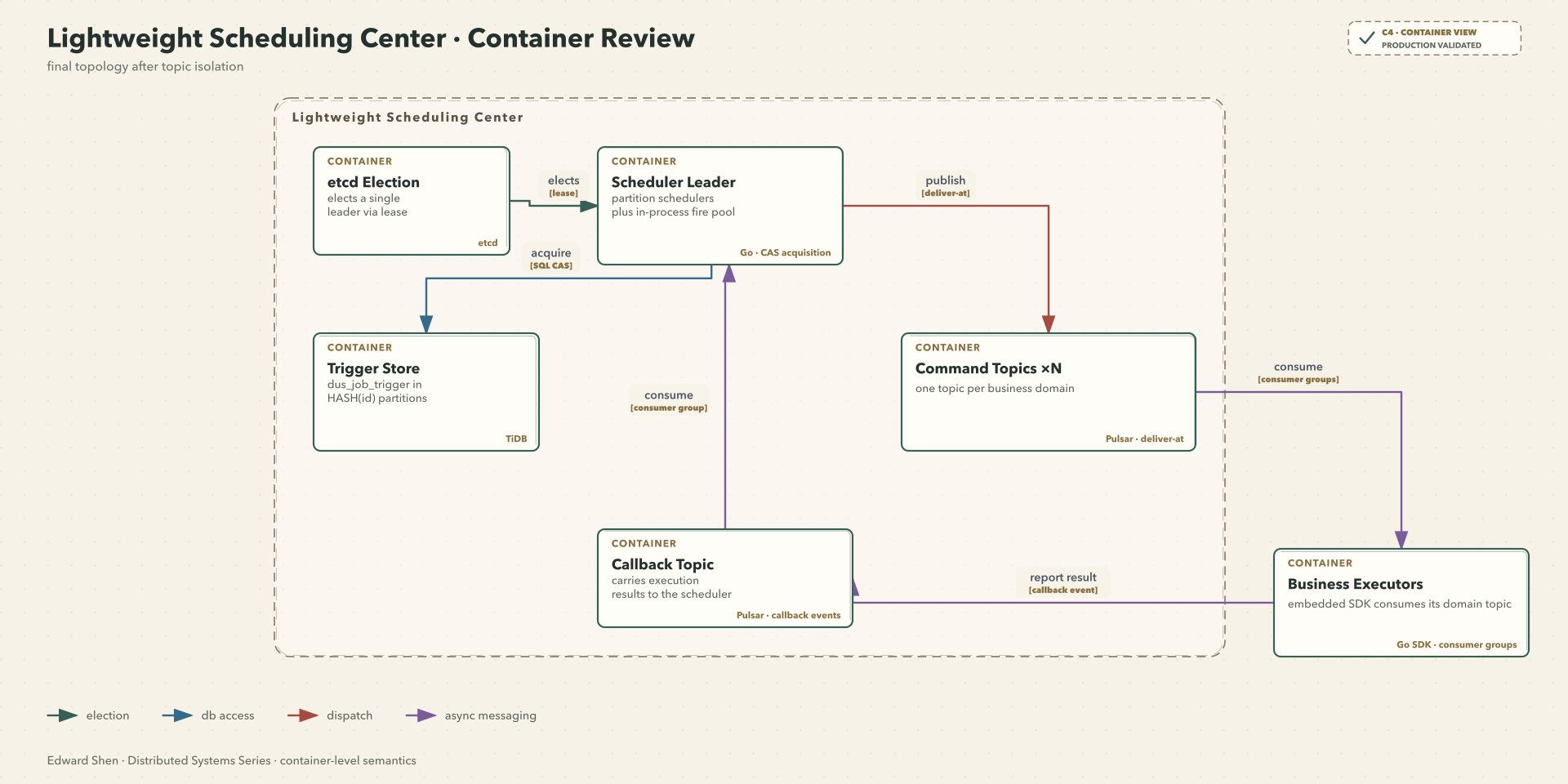
Reusing those systems kept the scheduler and executor SDK implementation to roughly 8,900 lines across 110 non-test Go files.
Key Technical Decisions
Leader election and acquire-loop ownership
The elected leader owned every TiDB partition scheduler and the bounded fire pool. This kept partition ownership and failure semantics simple: if the leader died, followers campaigned with exponential backoff and one took over. The cost was a one-process acquire-loop ceiling and a brief failover gap.
At larger scale, I would add an etcd-backed shard registry: each
scheduler pod would lease a subset of TiDB HASH(id)
partitions and own their acquire/fire pipeline, while etcd watched pod
liveness and reassigned partitions after failure. This would leave
pressure on TiDB and Pulsar but remove the single-pod admission ceiling
once partition count or on-the-hour bursts exceeded one pod's
capacity.
Partition-serial scheduling
The trigger table was hash-partitioned by ID in TiDB, with the partition count sized to expected business volume. The scheduler discovered partitions from table metadata and ran exactly one scheduling goroutine per partition inside the leader. Each goroutine queried its partition explicitly, so scan and admission were serial within that ownership range; the admitted batch was then handed off to the shared fire pool. This avoided concurrent acquire loops competing for the same partition, though TiDB still shared global storage capacity. Explicit partition selection kept each scan bounded to one scheduler; hash partitioning did not balance load by due time.
CAS as the admission boundary
Persistent transitions used conditional updates.
waiting -> acquired gated fire preparation;
acquired -> waiting or
acquired -> completed recorded the outcome. The domain
model used triggered only as a transient state while
preparing a fire batch; it was not separately persisted. CAS admitted
each row exactly once at the database boundary, but it did not fence a
previous leader that had already acquired rows — executor idempotency
and an explicit recovery contract were still required. Pause and resume
moved triggers through the same conditional-update API, so a manual
operation could not leave a state the scheduler would misread.
CAS also could not commit the TiDB state transition and Pulsar publication as one transaction. A leader could fail after acquiring a row, or after publishing a command but before recording its terminal outcome. Recovery therefore had to treat execution as at-least-once, and executor idempotency—not cross-store atomicity—closed the failure window.
            flowchart TD
    R([trigger created]):::event --> W([waiting]):::state
    W -->|CAS acquire| A([acquired]):::state
    A --> F[fire prepared]:::event
    F -->|one-shot complete| C([completed]):::state
    F -->|cron has next| N[cron next fire]:::event
    N --> W
    A -.->|dispatch failed| D[dispatch failed]:::event
    D -.->|release| W
    W -->|pause| P([paused]):::state
    P -->|resume| W

    classDef state fill:#eef7ff,stroke:#245a7d,stroke-width:2px;
    classDef event fill:#fff7e6,stroke:#8a6d3b,stroke-dasharray:3 3;
Coarse acquisition, precise delivery
The scheduler admitted triggers from a configurable lookahead and published each command with a deliver-at time equal to the trigger's fire time. After the first on-the-hour contention incident, production used a 30-minute window. This let DB polling be lazy and batchy while Pulsar preserved second-level delivery precision.
For one trigger, T was its scheduled trigger time, not
the acquire or publish time: T = trigger_at = next_fire_at
in TiDB and T = deliver-at in Pulsar.
Δ = T - acquire_time was its remaining lead time. In the
diagram, T - 30m 30.5s and T + 2h are
wall-clock offsets from T; the maximum early-admission lead
is 30m 30.5s (30s idle wait + 30m acquisition window + 0.5s
jitter). The diagram shows the normal early-admission path, where
Δ was positive.
            sequenceDiagram
    participant L as Lookahead
    participant S as Scheduler
    participant DB as TiDB
    participant Q as Pulsar
    participant E as Executor SDK

    Note over L,S: Maximum early admission: T - 30m 30.5s
    L->>S: trigger enters acquisition window
    S->>DB: CAS acquire
waiting -> acquired
    S->>Q: publish command
deliver-at = T
    Note over Q,E: Pulsar holds command until T
    Q->>E: deliver command at T
    Note over S,DB: Misfire horizon extends to T + 2h
This split the timing contract: TiDB retained the long-horizon
waiting row; Pulsar held only the admitted slice and
delivered it at next_fire_at.
The same failure window applied to leader election: an
acquired row had uncertain publication state. I would
persist an acquisition lease or epoch with every acquired
row and define its timeout transition, so a new leader could distinguish
an owner that might still be publishing from work it could safely
reclaim.
Fan-out through sharding items
The largest audience jobs did not expand into one trigger per audience member. Instead, each job carried sharding items that the fire pipeline paged through (300 per page), turning each item into its own execution command. Fired records were persisted per item so execution results could be tracked and aggregated through callbacks.
SDK execution instead of exposed HTTP callbacks
Legacy business services exposed HTTP callback endpoints; every integration needed a route, network ingress, and scheduler-to-business authorization. With the SDK, a service consumed its Pulsar command topic and invoked a registered function-level callback, so teams implemented handler logic rather than controller endpoints. The SDK then published an execution result to a separate Pulsar callback topic, which the scheduling center consumed to update fired-record results. Broker and SDK identity still required authorization, but the scheduler-to-business HTTP surface disappeared.
Implementation
Within the leader, each partition scheduler handed acquired batches to a bounded in-process fire pool. The fire pool provided up to 6,000 concurrent batch workers and served as the scheduler-side backpressure boundary. Its acquire loop ran once per tick:
- Compute the acquisition window: from the misfire floor — the older
of the partition's tracked latest
next_fire_atand two hours before now — to now plus the lookahead. The startup floor could reach seven days back. - Select
waitingtriggers in that window, ordered by due time, limited to the batch size — and capped by available capacity in the fire pool, so the scheduler never acquired more than it could hand off. - CAS the batch from
waitingtoacquired, confirm winners by re-reading state, then submit groups of up to 100 acquired triggers to the fire pipeline with retries. - If the fire pipeline rejected work repeatedly, release the triggers
back to
waitingso nothing was lost.
Production used a 30-minute acquisition window, a 30-second idle wait, up to 0.5 seconds of jitter, a two-hour misfire threshold, and a startup floor that could reach seven days back. A batch was capped at 300 triggers and submitted in chunks of 100.
The repository selected only the bounded due-soon slice from one explicitly chosen partition:
1 | FROM dus_job_trigger PARTITION (?) |
The SQL admitted by due time first. Trigger priority then acted as an
in-memory tie-breaker when selected triggers shared the same
next_fire_at; it was not a separate scheduling lane.
After CAS admission, the fire pipeline computed the next fire time or
marked completion, expanded sharding items, persisted fired records, and
published each command with deliver-at = fire time and a
job-code tag. Each business SDK consumed its domain command topic,
invoked the registered callback, and published the result to the
callback topic.
Purpose-built readers read old batch task tables and their change streams; a data flag made repeated migration idempotent. The SDK also emitted per-business migration telemetry: consumer lag, call volume, and execution success rate. For important scenarios whose handlers were already idempotent, we dual-ran the old and new paths and watched those signals before cutover. After load and functional tests against production traffic, migration proceeded from low-risk to critical scenarios.
Failure Modes / Production Challenges
Hot-minute contention
The first production stress pattern came from jobs scheduled at the same time. Hash partitioning spread trigger rows evenly by ID, but a large SOP workload placed many trigger runs at exact hour boundaries. Just before those boundaries, the acquisition scan found the burst and the partition-serial path became dominated by that workload. Other triggers behind it in the same partitions waited; the lookahead fell behind and the system spent subsequent ticks catching up.
Monitoring exposed the falling lookahead. We increased the
acquisition window to 30 minutes, worked with the business team to
replace exact :00 fire times with randomized seconds, and
used trigger priority as a same-time tie-breaker. Because SQL still
admitted by due time first, priority did not fully isolate workloads.
Scheduled delivery stayed on time; remaining pressure moved to
downstream consumers.
I would separate on-the-hour SOP traffic and lower-priority fan-out at creation time, giving each lane its own trigger table policy, capacity budget, topic, and cancellation semantics. Lookahead could adapt to per-domain fire-time lag and burst forecasts instead of using one global window.
Shared-topic backpressure
The next isolation failure came after onboarding the audience-SOP scenario. The SDK gave each business its own consumer group, so Pulsar showed exactly which subscription was falling behind. But all commands still entered one shared topic; its backlog produced producer backpressure and made a local problem platform-wide.
We split the topic per business domain. A slow consumer could then delay only its own domain while other businesses kept flowing and could be throttled or scaled independently. The diagrams show the resulting topic boundary. Topic-per-business-domain and per-business concurrency quotas would be initial SDK contracts in a new implementation.
A cancellation design we removed
Early admission created another contract problem: Pulsar did not support canceling a message after it was published with a future deliver-at time. We deployed a Redis-based design to production: publish set a state, consumption updated it, and the SDK filtered canceled commands while locks attempted consistency.
Production did not justify that complexity. Redis load rose, the lock-and-state path became hard to reason about, and debugging spanned TiDB, Pulsar, and Redis. Actual cancel demand was very low and downstream async handlers were already idempotent, so we removed the Redis layer and treated admission as the cancellation boundary.
Results
- Peak publish rate above 200K execution commands per second during on-the-hour workload peaks.
- Coverage of more than 20 business scenarios over the system's production lifetime.
- Full replacement of both the batch center and xxl-job, with a gradual per-business cutover and no big-bang migration.
The 200K+ figure came from the Pulsar Manager publish-rate panel: messages per second on the execution-command topics. For the SOP workload that drove the peak, one sharding item produced one command; larger fan-outs produced proportionally more.
We did not retain fire-time lag percentiles, so the publish rate establishes throughput without establishing end-to-end latency. I would instrument fire-time lag—the difference between a trigger's scheduled time and its actual delivery—as an SLI from day one, with alerts on platform-wide and per-domain percentiles.
Operating costs
Every state transition added write amplification on TiDB. Partition count became a capacity-planning burden, since changing it later is not free. At-least-once delivery required idempotent executors. The 30-minute lookahead absorbed hot-minute bursts but also widened the period during which an admitted trigger could no longer be canceled in the queue.
I would keep durable triggers in TiDB and admitted commands in
Pulsar, with per-domain command topics. The next change is operational:
persist ownership for acquired rows and expose per-domain
fire-time lag percentiles. That is a smaller correction than moving
long-lived task state into the queue.
Previous in this series: Debugging a Sporadic Go OOM in a Recursive JSON Encode Path.
Next in this series: Scaling Four Engineers to Eighteen Go Services with Generated Contracts.